Federated Learning and Synthetic Data: Training Across Organisations Without Sharing Raw Data
Federated learning promises to unlock collaborative AI training without centralising sensitive data. In practice, it runs into a predictable set of problems: data heterogeneity, small local datasets, communication inefficiency, and privacy attacks on gradient updates. Synthetic data resolves all four — and opens federated learning to organisations that would otherwise be excluded.
Federated Learning: The Promise and the Reality
Federated learning (FL) was introduced by Google in 2017 as a technique for training machine learning models across multiple devices or organisations without centralising training data. The premise: rather than sending data to a central server, each participant trains a local model update on their local data and sends only the model parameters (or gradients) to a central aggregator. The aggregator combines the updates — typically via weighted averaging — and distributes the improved global model back to participants.
The appeal for enterprises and regulated industries is obvious: a hospital network can collaboratively train a diagnostic AI without any hospital sharing patient records. A group of banks can train a shared fraud detection model without any bank exposing transaction data. This is the vision that has driven enormous investment in FL infrastructure over the past five years.
The practical reality is more complicated. FL deployments consistently encounter four problems that limit its effectiveness:
Problem 1: Non-IID Data Heterogeneity
Federated learning theory assumes that each participant's local data is independently and identically distributed (IID) — sampled from the same underlying distribution. In practice, data across federated participants is almost never IID. Different hospitals serve different patient demographics. Different banks serve different customer segments in different geographies. Different factories produce different products under different conditions.
Non-IID data causes federated optimisation to diverge: each local model update moves in a direction beneficial for its local distribution but potentially harmful for the global model. The more heterogeneous the participant distributions, the worse this divergence becomes, and the more communication rounds are needed to reach convergence — if convergence is achievable at all.
Problem 2: Small and Imbalanced Local Datasets
FL theory also assumes each participant has sufficient local data to produce meaningful model updates. In practice, many FL participants have small or heavily class-imbalanced local datasets. A regional hospital may have seen very few cases of a rare condition. A small bank may have seen very few confirmed fraud cases. Local training on these thin datasets produces noisy, high-variance gradients that destabilise the global model.
Problem 3: Communication and Computation Cost
Transmitting full model parameter updates is expensive at scale. Modern large models have billions of parameters — transmitting these even in compressed form consumes significant bandwidth and energy. Participants with limited connectivity (edge devices, geographically distributed organisations) may be unable to participate in full-model FL rounds.
Problem 4: Privacy Attacks on Gradient Updates
The security assumption underlying naive FL — that sharing gradients is privacy-safe because raw data is not shared — is false. Gradient inversion attacks can reconstruct training samples from gradient updates with high fidelity. Membership inference attacks can determine whether a specific data point was in a participant's local training set by analysing their gradient contributions. FL without differential privacy provides weaker privacy guarantees than it appears.
How Synthetic Data Solves Each Problem
Addressing Heterogeneity: Shared Synthetic Anchors
A central coordinator can generate a small shared synthetic dataset — a "synthetic anchor" — representing the target global distribution. This synthetic dataset is distributed to all participants and included in local training alongside the participant's real local data. The synthetic anchor acts as a regulariser, pulling local updates toward the global distribution and dramatically reducing heterogeneity-induced divergence.
Addressing Small Datasets: Local Synthetic Augmentation
Participants with small local datasets can use synthetic data augmentation to increase their effective local training set size. Each participant fits a local generative model to their real data and generates synthetic augmentation samples — entirely on their local device, with no synthetic data leaving the participant. The augmented dataset produces more stable local model updates, reducing variance in the federated aggregation.
This is particularly valuable for rare class augmentation: a hospital with five local cases of a rare disease can generate synthetic variants of those five cases to produce meaningful local training signal, rather than contributing near-zero gradient updates for the rare class.
Addressing Communication Cost: Synthetic Data Compression
Instead of transmitting model parameter updates, participants can transmit a compact synthetic dataset that encodes their local data distribution. The aggregator uses the received synthetic datasets to train the global model centrally — with no raw data ever leaving any participant. This reduces communication from model-size (billions of parameters) to dataset-size (thousands of synthetic records), a reduction of several orders of magnitude.
Addressing Privacy Attacks: Synthetic Data Instead of Gradients
When participants share synthetic data rather than gradients, gradient inversion attacks are impossible by construction — there are no gradients to invert. The privacy guarantee is now entirely determined by the privacy properties of the synthetic data itself, which can be formally quantified and audited. This represents a cleaner, more auditable privacy model than gradient-based FL with differential privacy noise. The full implications are explored in our article on the AI data paradox in regulated industries.
Architecture: Federated Synthetic Data Sharing
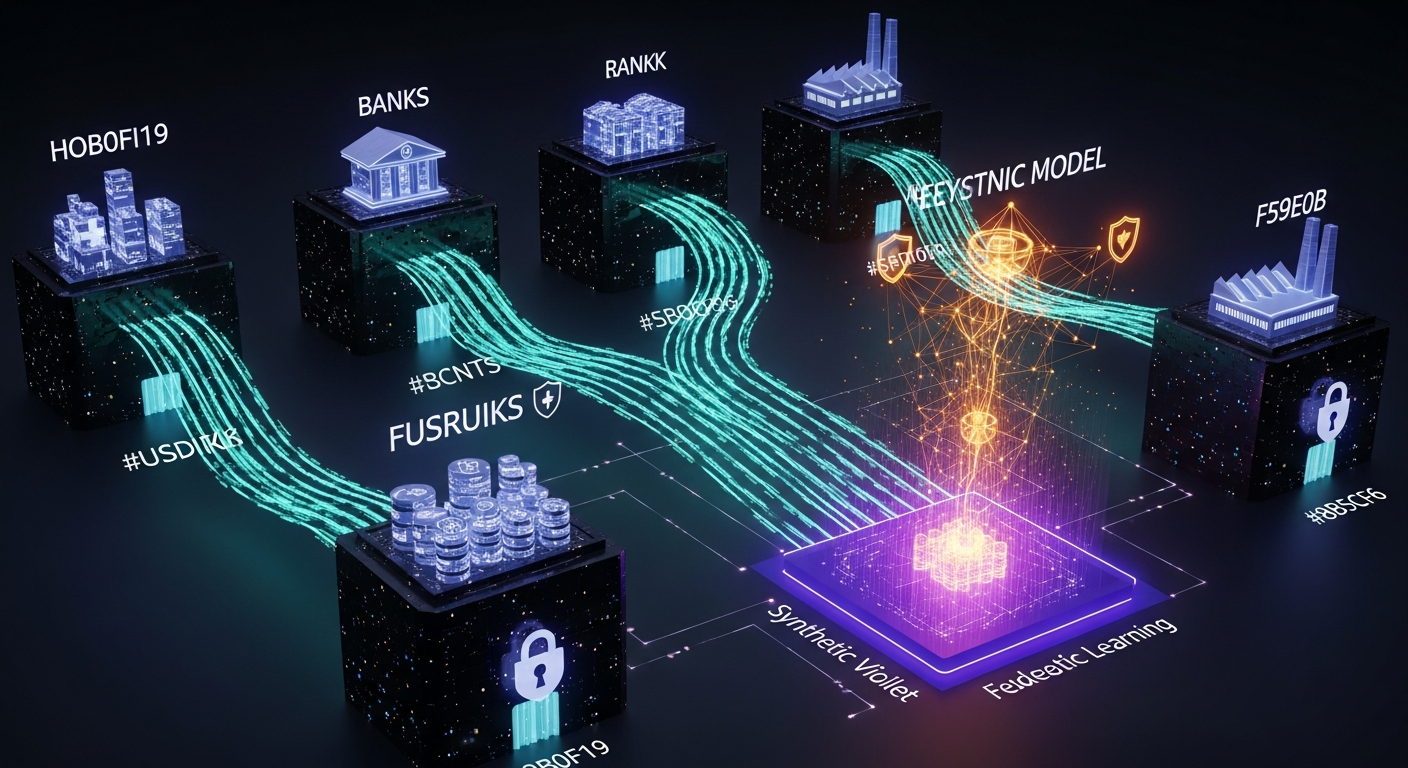
The cleanest architecture for privacy-preserving cross-organisational AI training combines FL with synthetic data sharing:
- Local generative model training — each participant trains a generative model (VAE, GAN, or statistical model) on their local private data. The generative model never leaves the participant's environment.
- Synthetic data generation and privacy audit — each participant generates a synthetic dataset from their local generative model and audits it against privacy metrics (membership inference resistance, nearest-neighbour distance). Only datasets that pass the audit are eligible for sharing.
- Synthetic data contribution — participants contribute their synthetic datasets to a shared pool. The shared pool contains no real personal data.
- Global model training — a central or distributed training process trains the global AI model on the combined synthetic dataset pool.
- Model distribution — the trained global model is distributed back to all participants, providing a model that has effectively learned from all participants' data without any participant exposing their real data.
Real-World Applications
- Healthcare consortia — hospital networks jointly training diagnostic AI models for rare diseases, where each institution's local case count is insufficient but their combined synthetic datasets are
- Financial crime intelligence — banks sharing synthetic representations of fraud patterns across a consortium, building a shared detection model that sees cross-institution attack vectors without exposing any real customer data
- Industrial IoT benchmarking — manufacturers contributing synthetic sensor signatures of failure modes to build a shared predictive maintenance model, each protecting their proprietary operational data
- Cross-border regulatory compliance — organisations in different jurisdictions contributing synthetic data to a shared compliance model, with each jurisdiction's data staying within its legal boundary
Frequently Asked Questions
What is federated learning?
Federated learning is a machine learning approach where a model is trained collaboratively across multiple participants (devices or organisations) without centralising their training data. Each participant trains on local data and shares model updates — not raw data — with a central aggregator that combines them into a global model.
Why is standard federated learning not enough for privacy?
Gradient inversion attacks can reconstruct training samples from the gradient updates shared in standard FL. This means sharing gradients is not equivalent to sharing no data — private information leaks through the gradient updates. Differential privacy adds noise to gradients, but calibrating the noise requires a tradeoff between privacy and model quality that is difficult to audit formally.
What is a synthetic anchor in federated learning?
A synthetic anchor is a small shared synthetic dataset distributed to all FL participants and included in their local training. It represents the target global distribution and acts as a regulariser, reducing the divergence caused by heterogeneous local data distributions. The anchor contains no real personal data and can be freely shared.
How does synthetic data reduce FL communication cost?
Instead of transmitting model updates (billions of parameters), participants can transmit compact synthetic datasets (thousands of records). The central coordinator trains the global model on the received synthetic datasets. Communication cost drops by several orders of magnitude, making FL practical for bandwidth-constrained participants.
Can synthetic data replace federated learning entirely?
In some scenarios, yes. If each participant's local generative model is sufficiently expressive and the privacy audit is sufficiently rigorous, sharing synthetic datasets and training centrally can outperform gradient-based FL on both privacy and model quality. The choice depends on data volume, generative model quality, and the required privacy guarantee level.
AllSynthetica's privacy-audited synthetic datasets are designed for federated and multi-party learning scenarios — providing formally quantified membership inference resistance, nearest-neighbour privacy guarantees, and full audit trails for regulatory review.