
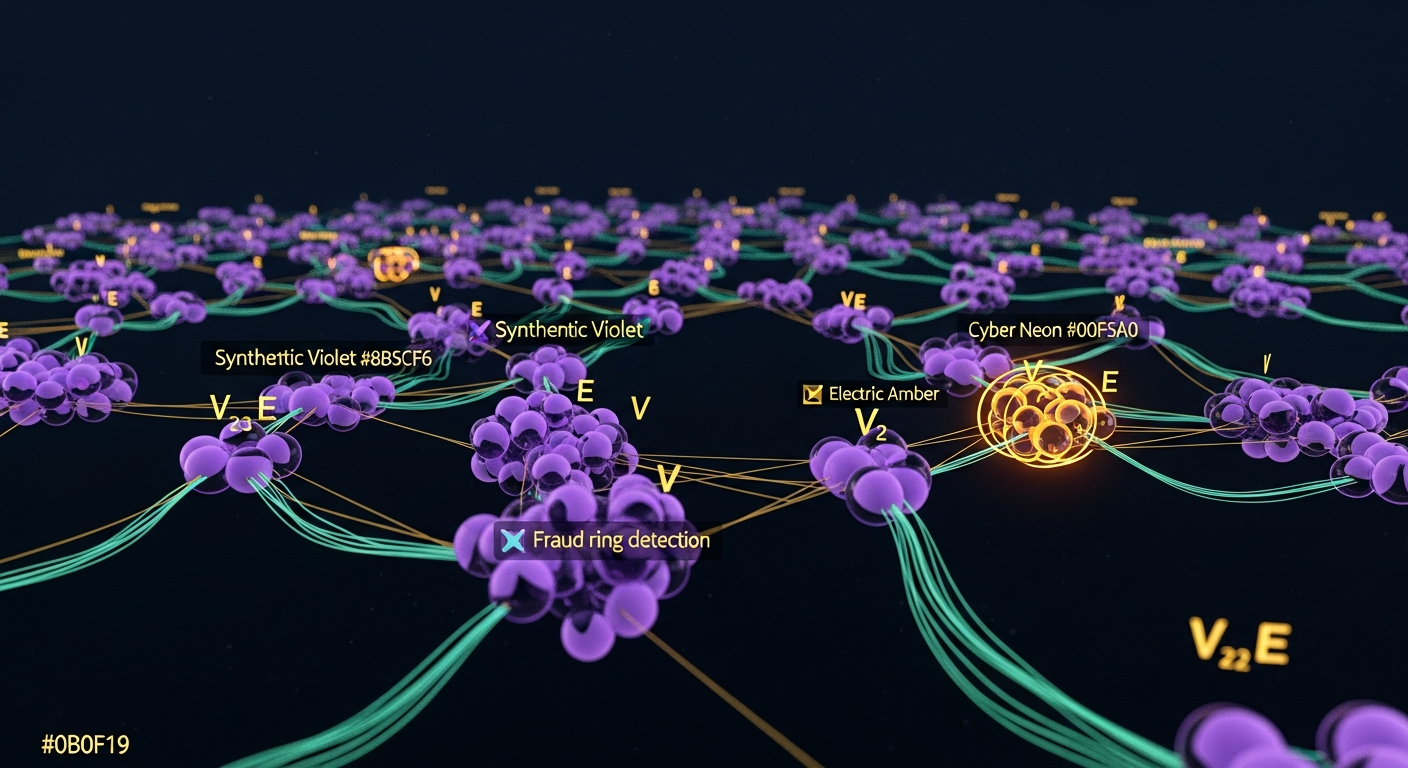
Synthetic Graph and Network Data: Training AI on Fraud Rings, Knowledge Graphs, and Social Networks
Tabular and image synthetic data are well-understood. Graph data is not. The topology of a network — how nodes connect, cluster, and form communities — is as statistically significant as any numerical attribute. Generating synthetic graphs that preserve these structural properties is one of the hardest open problems in synthetic data, and one of the most consequential for fraud detection, knowledge graph AI, and network analysis.
Why Graph Data Is Structurally Different
In tabular data, each row is independent. Generating a synthetic row requires sampling from the joint distribution of its columns — a well-studied problem. In graph data, each node is connected to other nodes, and those connections carry information. The neighbourhood of a node — which other nodes it connects to, the structure of those connections, the paths between them — is as important as any attribute stored on the node itself.
A synthetic graph that preserves node attribute distributions but randomises the edge structure is useless for graph neural network (GNN) training. The GNN's message-passing mechanism aggregates information from a node's neighbourhood. If the neighbourhood structure is random, the aggregated features are noise, and the model learns nothing.
This makes graph synthesis fundamentally harder than tabular synthesis. You need to simultaneously preserve:
- Degree distribution — the distribution of how many connections each node has (typically heavy-tailed: most nodes have few connections, a few nodes have many)
- Clustering coefficient — the probability that two nodes connected to the same node are also connected to each other (how "cliquey" the network is)
- Community structure — dense subgraphs of nodes that are more connected internally than externally (fraud rings, organisational units, topic communities)
- Path length distribution — the distribution of shortest paths between node pairs (the "small world" property)
- Node-edge attribute correlations — how node and edge attributes correlate with structural position (hub nodes have different attribute distributions than peripheral nodes)
Key Applications Requiring Synthetic Graph Data
Financial Fraud Ring Detection
Modern financial fraud is network-based. Individual fraudulent transactions look unremarkable in isolation — small amounts, plausible merchants, normal timing. The fraud signature emerges from the graph: a ring of accounts that cycle money between them, a cluster of accounts with shared identifiers (same phone number, same device, same IP range), a bipartite graph between mule accounts and beneficiary accounts.
Training a GNN-based fraud detector requires synthetic transaction graphs with realistic fraud ring structures. Real fraud graphs are sensitive — they reveal investigation tactics and confirmed fraud patterns — and are heavily restricted by privacy regulations, as explored in our article on the AI data paradox in regulated industries. Synthetic fraud graphs that preserve community structure, degree distribution, and the statistical signature of fraud rings allow fraud detection models to be trained, tested, and explained without exposing real customer data.
Knowledge Graph Augmentation
Enterprise knowledge graphs — encoding relationships between products, customers, suppliers, regulatory entities, and business concepts — are used to power recommendation engines, compliance reasoning systems, and enterprise search. Training and testing KG embedding models (TransE, RotatE, ComplEx) requires large, dense graphs with realistic relation type distributions.
Real KGs are often sparse in important relation types (rare entity combinations, infrequently occurring relations) and constrained by confidentiality in others. Synthetic KG augmentation generates new triples consistent with the real graph's ontology and statistical relation distribution — providing training density where the real graph is thin.
Social and Organisational Network Analysis
Analysing organisational communication networks, professional social graphs, or academic collaboration networks requires realistic network topologies for algorithm development and model validation. Real social graphs carry significant privacy risk — who is connected to whom is itself sensitive personal data. Synthetic social graphs preserving the statistical properties of real networks allow research without individual exposure.
Synthetic Graph Generation Approaches
Classical Statistical Models
Classical graph generation models parameterise specific structural properties:
Classical models are fast and interpretable but struggle to simultaneously match multiple structural properties and are unable to generate realistic node/edge attributes correlated with structure.
Deep Generative Models for Graphs
Modern deep graph generation approaches learn the full joint distribution of graph structure and attributes from real examples:
- GraphVAE — variational autoencoder adapted for graph-structured data; encodes graphs into latent vectors and decodes new graphs from sampled latent points
- GraphRNN — autoregressive model that generates graphs node-by-node and edge-by-edge, preserving sequential structural dependencies
- GRAN (Graph Recurrent Attention Networks) — generates graphs in blocks, maintaining long-range structural coherence
- DiGress — diffusion model for discrete graph generation; state-of-the-art on benchmark graph generation tasks as of 2025
Privacy-Preserving Graph Synthesis
For sensitive graphs (financial networks, medical comorbidity graphs, communication networks), differential privacy must be applied to the graph generation process. Edge-level DP protects whether any individual connection exists; node-level DP protects whether any individual node is present. The privacy budget must be allocated between structural and attribute components of the generator.
Evaluating Synthetic Graph Quality
Standard synthetic data quality metrics are insufficient for graphs. Graph-specific metrics required:
- Maximum Mean Discrepancy (MMD) on graph statistics — degree distribution, clustering coefficient, orbit counts
- Fréchet Inception Distance adapted for graphs (FID-G) — measures distance between real and synthetic graph embedding distributions
- GNN downstream performance — does a GNN trained on synthetic graphs achieve the same node/graph classification performance as one trained on real graphs?
- Community structure preservation — do standard community detection algorithms (Louvain, Leiden) recover the same community count and size distribution in synthetic graphs?
- Link prediction consistency — does the synthetic graph's statistical structure support the same link prediction task performance?
Frequently Asked Questions
What is synthetic graph data?
Synthetic graph data is artificially generated network data — nodes, edges, and their attributes — that preserves the statistical properties of a real graph (degree distribution, clustering, community structure) without containing any real individual's connection information.
Why is graph synthesis harder than tabular synthesis?
Tabular synthesis only needs to preserve joint attribute distributions across independent rows. Graph synthesis must additionally preserve the topology — how nodes connect — and the correlations between topology and attributes. Randomising edges while preserving attributes produces graphs that are useless for graph neural network training.
How is a fraud ring simulated with synthetic graph data?
Fraud rings are modelled using the Stochastic Block Model: a community of densely interconnected accounts with a specific pattern of transactions between them and a sparse connection to the broader legitimate transaction network. Synthetic fraud rings are calibrated to match the statistical signature of real detected rings without exposing the real account identities.
What graph neural network architectures benefit most from synthetic training data?
Message-passing GNNs (GCN, GraphSAGE, GAT) are most sensitive to neighbourhood structure quality because they aggregate features from multi-hop neighbourhoods. Graph transformers benefit from synthetic data that preserves global structural statistics used in positional encoding. Link prediction models require synthetic graphs with realistic community structure to learn meaningful edge embeddings.
Can differential privacy be applied to graph generation?
Yes, but graph DP is more complex than tabular DP. Edge-level DP (protecting individual connections) requires careful sensitivity analysis because removing one edge can change many graph statistics. Node-level DP is stricter, protecting the entire neighbourhood of a node. Both add noise to the generation process and reduce statistical fidelity; the privacy-utility tradeoff must be calibrated to the application.
AllSynthetica supports synthetic graph generation for financial transaction networks, knowledge graphs, and organisational networks — preserving degree distribution, community structure, and node-attribute correlations with configurable differential privacy guarantees.